
This website uses cookies so that we can provide you with the best user experience possible. Cookie information is stored in your browser and performs functions such as recognising you when you return to our website and helping our team to understand which sections of the website you find most interesting and useful.
Living in a Female Body That Feels So Much
Being a woman means living in a female body that consists mostly of water and feels so much that it can often be overwhelming. But what does this actually mean? What impact does it have on our experience and daily life? And above all: how can we treat this body in a way that suits it and learn to live with it?
For many years of my life, I didn’t know what to do with my body. I remember clearly when the feeling started—probably around puberty. Activities I used to enjoy, like playing soccer, suddenly became uncomfortable because my growing breasts hurt. That was still mild compared to what was to come.
What happened next…
My period started—and with it came a wave of pain, bleeding, and emotional turbulence. Feelings that not only troubled me but also burdened those around me. I had no guidance on how to deal with it. So I did what felt safest: I looked away, blocked out much, and functioned as best I could. I wanted to be like a man: strong, tough, always controlled and independent.
Everything in me that was soft, round, and abundant—my femininity—felt alien and too much.
This led to an inner rejection of my own body, which eventually culminated in anorexia. At 16, I weighed only 28 kilograms and spent nine months in the hospital. But physical healing alone was not enough. My soul remained hurt because no one truly understood what I was missing and how deep my pain was.
I believe a generational trauma plays a major role in post-war German society. Women from my grandmother’s generation had to endure harsh times: war, flight, violence, survival. Feelings, vulnerability, and care for the soul often had no place. This emotional hardness was unintentionally passed on as a survival strategy.
Those who built such a protective shell and raised children themselves had little room for softness or sensitivity.
My own story reflects this. My grandmother carried the war trauma deeply within her, my mother grew up in a world of post-war discipline, and I was raised with the motto: “All doors should be open for you, but you must fight to become something.” I sought myself outside, wanted to prove myself, compete, and control. But eventually, my body and soul couldn’t keep up.
Three surgeries on my uterus—no coincidence. My attitude toward men, shaped by competition, brought no peace or healthy balance. It burdened my relationships, my job, and my life as a woman.
The Journey into Feminine Power
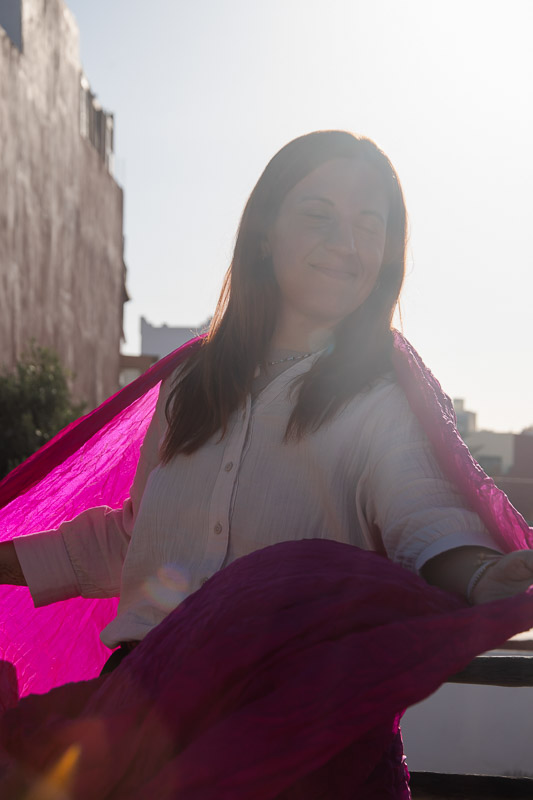
My healing began when I learned that true strength in femininity does not lie in hardness or struggle. Softness is not weakness but a powerful source. Accepting my body, resting in my center, being instead of doing—all this makes me wonderfully strong and lets me shine.
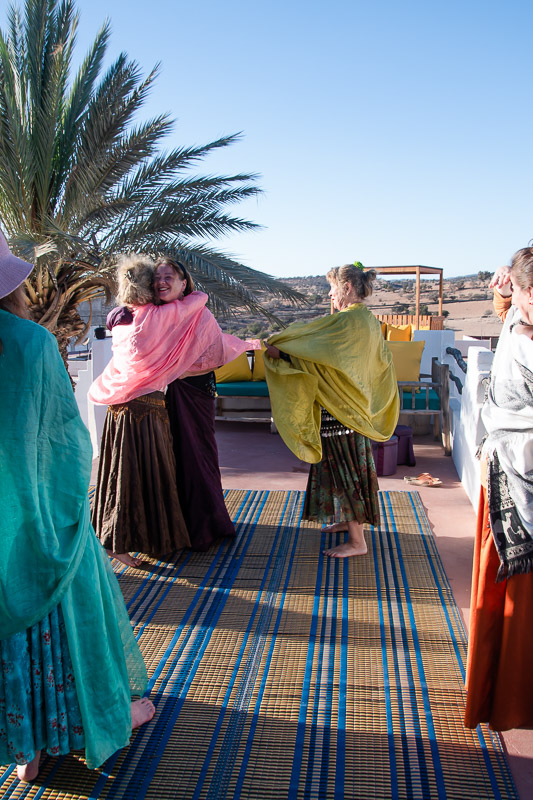
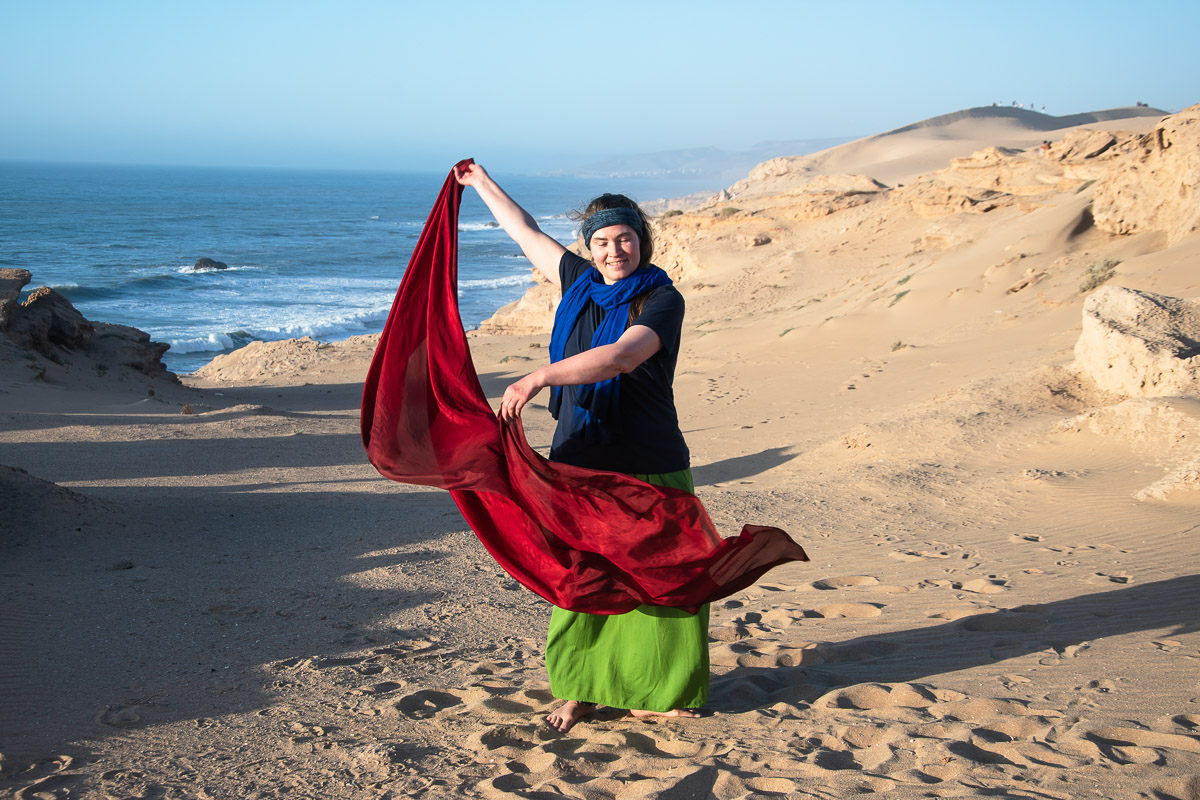
Dance and my voice became my greatest healers. Especially the Egyptian women’s dance, Raqs Sharqi, showed me how to come into flow, how slowness and stillness bring strength. Not belly dance, which often emphasizes doing and outward display, but a dance that connects us with our body. My feet root, my spine grows tall, my breath deepens—I feel how much power lies in pure presence. Softness gives permeability—and that makes one beautiful.
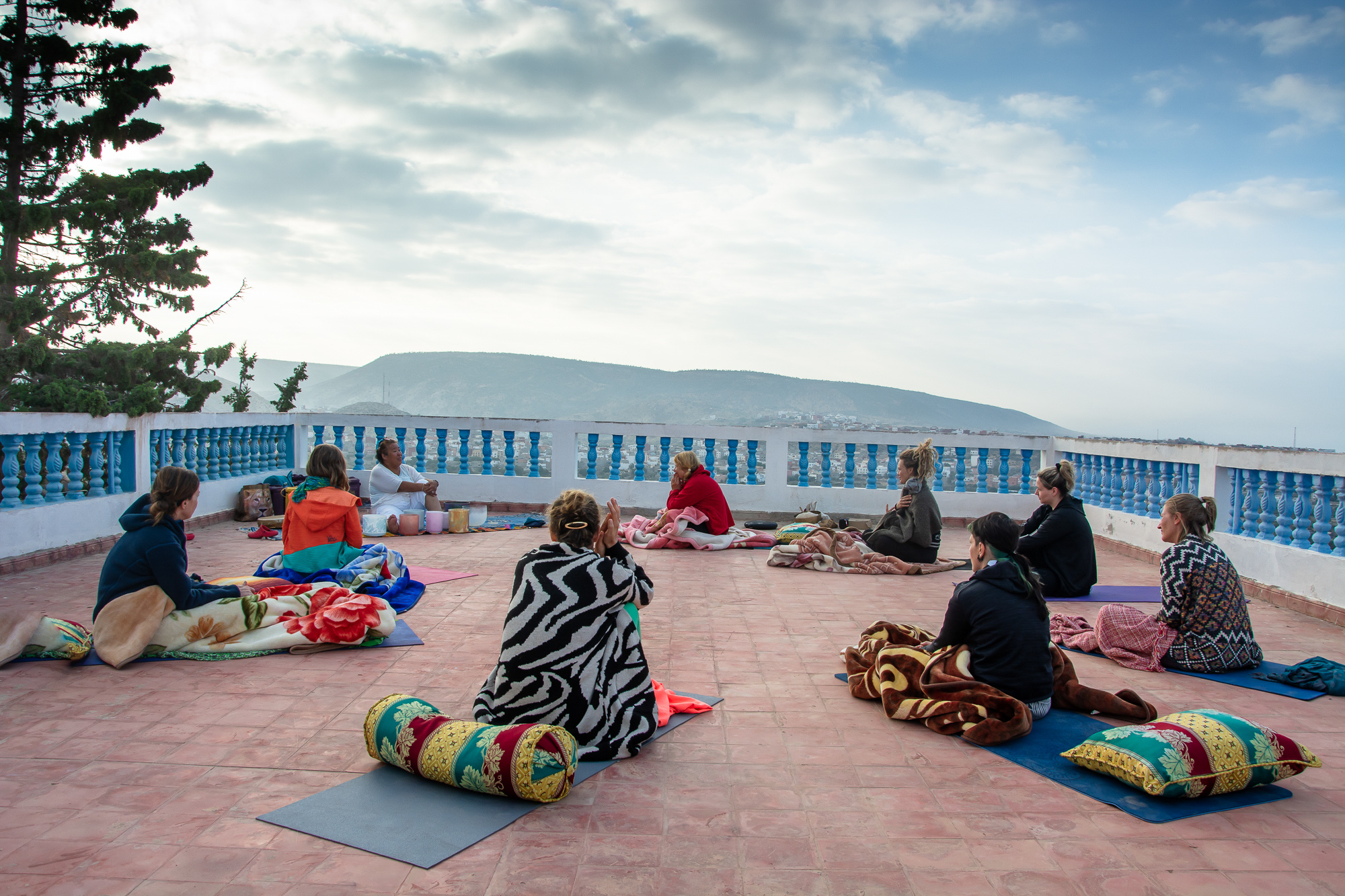
I discovered my voice as a healing instrument. Singing and toning not only vibrate through my body but also release blockages, free emotions, calm the nervous system, and ease pain. My voice helps me to arrive in the here and now and be with myself.
Invitation to Healing and Coming Home
If this resonates with you and you’re curious to experience what it means to truly be at home in your body, then I invite you to my retreat in Morocco: Dance meets Soundhealing.
Together with my dance teacher Erna Fröhlich and my shamanic friend Tomoko, we dive deeper within. We grow quieter, rediscover our strength, our flow, and our superpower—for our own healing and the healing of our world.
What is Raqs Sharqi?
Raqs Sharqi is an Egyptian women’s dance whose name means “Dance of the East” in Arabic. This dance has a millennia-old tradition and is one of the most original forms of female dance. Raqs Sharqi combines powerful grace with soft composure and expresses femininity, dignity, and self-expression. It’s not just about dancing but also about flowing, resting within oneself, and bodily presence.
Unlike the often-called belly dance, which sometimes emphasizes outer performance and doing, Raqs Sharqi is more a conscious, inner bodily experience that connects body, mind, and soul.
The dance originated in Egypt and was practiced by various social groups—from common folk to the elite courts—and has evolved to this day. It expresses female strength and self-awareness through slow, earthy, and flowing movements, revealing a woman’s natural beauty and power.
Raqs Sharqi is thus a path to feel, honor, and immerse oneself in one’s femininity and bodily presence—exactly what you describe as a valuable experience and healing in your text.
In short: Raqs Sharqi is more than a dance—it is an expression of female power that brings body, emotions, and personality into harmony.
Soundhealing with One’s Own Voice
Soundhealing with your own voice is a powerful method where the sound and vibrations of your own singing or toning are used to support healing processes in body and mind. The voice is seen as an instrument that, through vibrations, can dissolve blockages, calm the nervous system, and release emotional tensions.
In voice soundhealing, you produce sounds, tones, or mantras that influence your nervous system and energy centers (chakras) in the body. Creating and consciously perceiving your own voice encourages stress release, deeper relaxation, and connection with your own body. Your voice vibrates throughout your entire body, often activating unconscious physical and emotional processes that contribute to healing.
This form of soundhealing is especially intimate and personal because it works from within and needs no external instruments. It enables you to feel yourself, be present, and express your inner world audibly and tangibly.
In short: Soundhealing with your own voice uses the body’s natural vibrational potential to harmonize it, dissolve inner blockages, and promote emotional healing—an effective and deeply personal path to well-being.